

There’s a room in your house you haven’t built yet.
You’ve been in the right kind of backyard before — at a friend’s place, maybe, or somewhere you stayed once.
You stepped outside and didn’t immediately look for a reason to go back in. The light was right.
The air moved.
Someone handed you a drink and you found a seat and stayed there, unhurried, for longer than you expected. The afternoon stretched. The evening arrived quietly and nobody marked it.
You didn’t call it a patio. It didn’t feel like one.
Most backyards in Northern Virginia don’t feel like that. They feel like what they are — a flat surface between the house and the garden, serviceable, inert, waiting for you to make something of them.
You wander out, spend twenty minutes not quite comfortable, and drift back inside. The furniture stays out all summer and you use it four times.
That’s not a problem with your backyard. It’s a design problem. And design problems have answers.
The outdoor living room begins where most patios never arrive: genuine comfort.
Not “tolerable when the weather cooperates” comfortable.
The kind where you sink into the seat and don’t think about leaving. Deep cushions rated for the elements.
A custom pergola or pavilion that handles the afternoon sun without closing the space in. A ceiling fan turning slowly overhead on a humid Virginia evening.
A rug underfoot that makes the whole thing read as a room rather than a yard.
These aren’t upgrades. They’re the foundation.
When an outdoor living space is genuinely comfortable, the way you use it changes completely. You stop visiting it and start living in it.
You have your morning coffee there before the day begins. Your children drift toward it after school without being asked. On a Saturday that’s gone well, you find yourself still outside at nine in the evening — not because you planned to stay, but because nothing has given you a reason to go back in.
That’s the whole point.
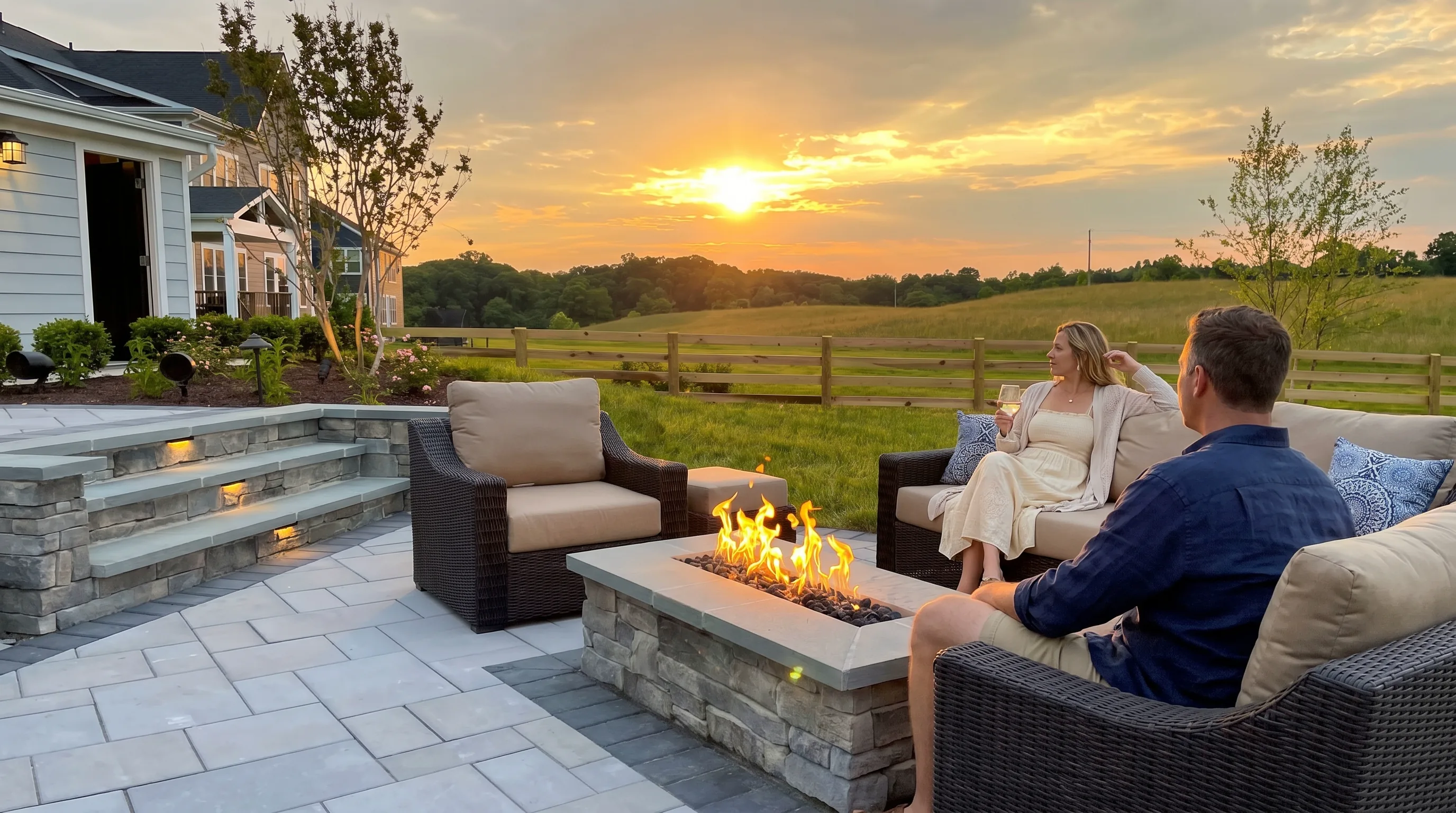
There is something ancient about a fire. It pulls people in. It slows conversation down. Everyone gravitates toward it, the phones disappear, and the hour stops feeling like something to get through.
A fire pit or outdoor fireplace — set at the centre of a custom patio design or built into an outdoor living structure — does what a fireplace has always done for an interior room: it gives the space gravity.
A reason to gather. Somewhere to look when the conversation pauses.
Built well, it’s also one of the most useful design decisions you can make. Fire extends your Northern Virginia season by months.
A cool April evening that might have ended at eight o’clock becomes the kind of evening people talk about the following week.
October, which should by all rights be the end of things outside, becomes one of the best months to be in your garden. You’re warm, the leaves are falling, and the fire is doing exactly what fires do.
The practical and the beautiful rarely align this cleanly.
We understand the hesitation. It sounds like a certain kind of excess — a television, outside, mounted to the pergola.
Then someone watches the game out there for the first time.
Outdoor entertainment systems have matured into something genuinely serious: weatherproof displays engineered for direct sunlight, humidity, temperature extremes, and the kind of casual neglect that outdoor things endure.
They aren’t novelties. They’re part of how people actually use custom outdoor living spaces now.
Sunday football with something on the grill and the autumn air coming through. A film on a Friday night with the children piled onto the outdoor sofa and the sky going dark overhead.
The kind of evening that costs you nothing and becomes a memory regardless. These aren’t hypothetical scenarios.
They’re what happens when a deck or patio is designed — from the beginning — to invite that kind of use.
A television signals something to the space. It says: this is for living in, not passing through.
Most patios in Fairfax County and the surrounding area earn four months a year, if that. Furniture comes out of storage in May. It goes back in September.
In the months either side, you look out the window at something you’re not using.
A covered deck or louvered pergola keeps the rain off in April and provides shade when July makes everything else unbearable.
An infrared heater mounted overhead pushes warmth down on cool evenings without the drama of a fire. A fire feature handles the rest: the shoulder seasons, the late autumn nights, the winter evenings that shouldn’t work but do.
The outdoor living space you now occupy eleven months of the year — that’s not an addition. That’s the best room in the house.
The investment case makes itself when you actually run the numbers.
Cost per day of use, over a decade, for a space that’s genuinely part of your life.
The question stops being whether you can afford it and starts being why you waited.
xScape has been designing and building outdoor living spaces across Northern Virginia since 2004 — serving Fairfax, Loudoun, and Prince William counties, from McLean to Middleburg, Great Falls to Gainesville.
What makes the work different isn’t the materials or the craftsmanship, though both matter.
It’s the approach: deck design, patio construction, pergola building, and landscaping as a single decision rather than two separate conversations.
The structure, the hardscape, the plantings — considered together, so the transition from your back door to wherever you want to be is seamless.
We look past the construction to the moment the furniture is set and the first fire is lit.
The first conversation costs you nothing. Tell us what you’re working with — the space you have, the life you’re imagining for it — and we’ll show you what’s possible.



.jpeg)
.jpeg)